10 Powerful Python AI Libraries Every Developer Should Know
Discover the top Python AI libraries every developer should know. Learn about TensorFlow, PyTorch, Scikit-learn, and more to build powerful AI and machine learning applications.

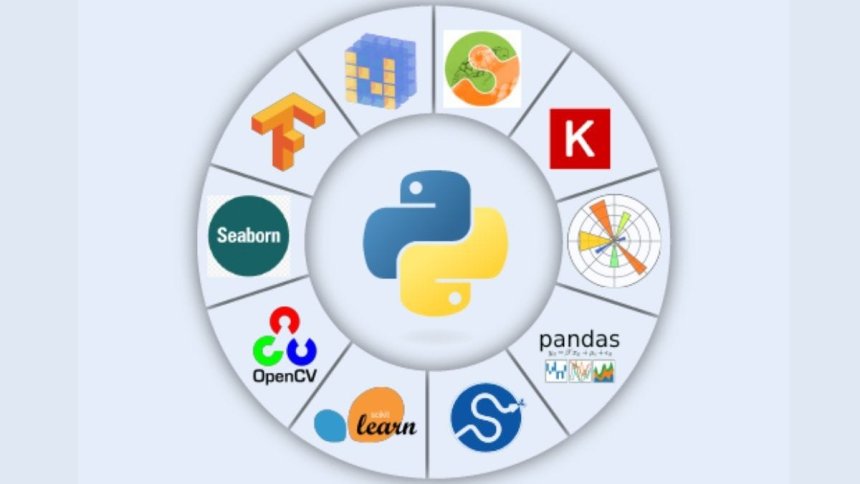
When it comes to building Artificial Intelligence applications, Python stands out as the most preferred programming language. But what truly makes Python powerful in AI development is its ecosystem of libraries.
These libraries eliminate the need to build complex algorithms from scratch. Instead, developers can focus on solving real-world problems while relying on optimized and well-tested tools.
In this article, we’ll explore the top 10 Python AI libraries that every developer should know and understand.
1. NumPy
NumPy is the foundation of almost all AI and machine learning libraries in Python. It provides support for large multi-dimensional arrays and mathematical operations.
Without NumPy, most data processing tasks in AI would be significantly slower and more complex.
2. Pandas
Pandas is used for handling and analyzing structured data. It is especially useful for cleaning datasets before feeding them into machine learning models.
Data preprocessing is a critical step in AI development, and Pandas makes this process efficient.
3. Scikit-learn
Scikit-learn is one of the most beginner-friendly machine learning libraries.
It provides tools for:
-
Classification
-
Regression
-
Clustering
-
Model evaluation
It’s perfect for developers who are just starting with machine learning.
4. TensorFlow
TensorFlow is a powerful deep learning framework developed by Google.
It is widely used for building neural networks and large-scale AI systems such as:
-
Image recognition
-
Natural language processing
-
Recommendation systems
5. PyTorch
PyTorch is another popular deep learning library, especially favored by researchers.
It offers flexibility and dynamic computation graphs, making it easier to experiment with new AI models.
6. Keras
Keras is a high-level API that runs on top of TensorFlow.
It simplifies the process of building neural networks and is ideal for beginners in deep learning.
7. OpenCV
OpenCV is used for computer vision tasks such as image processing and object detection.
It is widely used in applications like:
-
Face detection
-
Motion tracking
-
Image filtering
8. spaCy
spaCy is a powerful library for Natural Language Processing.
It is commonly used for:
-
Text analysis
-
Named entity recognition
-
Language modeling
9. NLTK
NLTK is another popular NLP library used for educational purposes and research.
It provides tools for tokenization, parsing, and text processing.
10. Matplotlib
Matplotlib is used for data visualization.
Visualizing data is important in AI because it helps developers understand patterns and model performance.
How to Choose the Right Library
Choosing the right library depends on your project requirements.
If you are working with structured data, Pandas and NumPy are essential.
For machine learning models, Scikit-learn is a great starting point.
If your project involves deep learning, TensorFlow or PyTorch would be more suitable.
For text-based applications, spaCy and NLTK are ideal choices.
Real-World Usage
Most real-world AI applications use a combination of these libraries.
For example:
A recommendation system might use Pandas for data processing, Scikit-learn for modeling, and Matplotlib for visualization.
An image recognition system might combine OpenCV with TensorFlow.
This combination of tools is what makes Python extremely powerful for AI development.
Tips for Developers
Instead of trying to learn all libraries at once, focus on mastering a few based on your goals.
Start with:
-
NumPy
-
Pandas
-
Scikit-learn
Then gradually move toward:
-
TensorFlow or PyTorch
-
NLP libraries like spaCy
Building projects using these libraries will help you understand their practical usage better.
Conclusion
Python’s strength in Artificial Intelligence comes from its rich ecosystem of libraries. These tools make it possible to build complex AI systems without needing deep expertise in mathematical implementation.
By learning and using the right libraries, developers can create powerful applications in machine learning, deep learning, computer vision, and natural language processing.
Whether you are a beginner or an experienced developer, understanding these libraries is essential for your AI journey.
Share
What's Your Reaction?
 Like
0
Like
0
 Dislike
0
Dislike
0
 Love
0
Love
0
 Funny
0
Funny
0
 Angry
0
Angry
0
 Sad
0
Sad
0
 Wow
0
Wow
0