Building AI Agents with Multi-Step Reasoning: Advanced Developer Guide (2026)
Learn how developers can build AI agents with multi-step reasoning, task planning, and tool execution using modern AI APIs and scalable backend architecture.

Introduction: From Chatbots to Autonomous AI Systems
Early AI applications simply responded to user questions.
Modern AI systems can plan, reason, and execute tasks step-by-step.
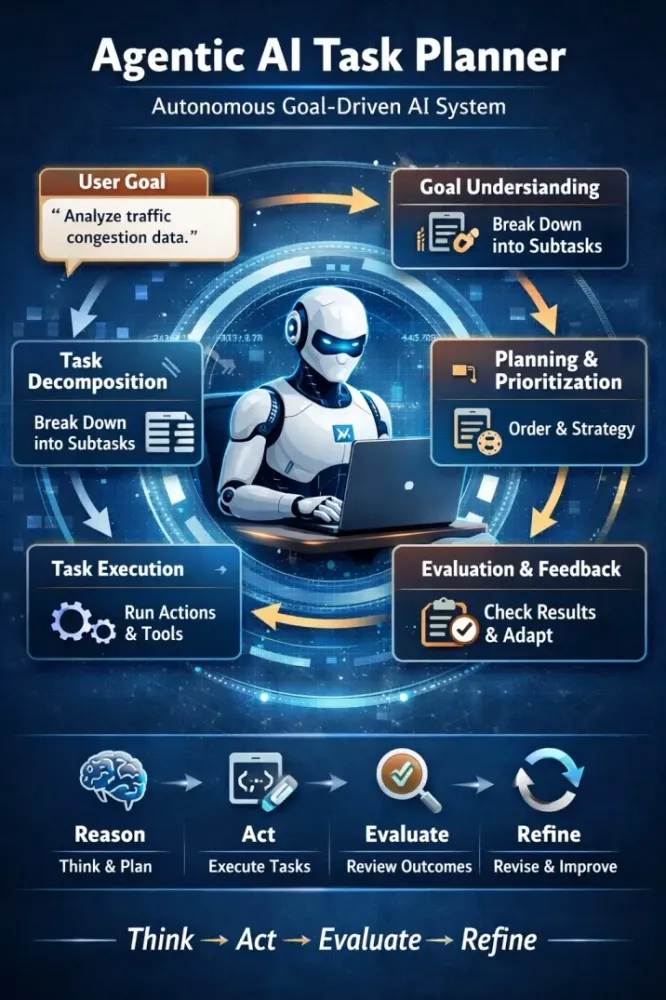
These systems are called AI agents with multi-step reasoning.
Platforms like OpenAI provide powerful models capable of advanced reasoning similar to what powers assistants like ChatGPT.
But to build real autonomous systems, developers must design task planning and execution layers.
What Is Multi-Step Reasoning?
Multi-step reasoning means the AI:
-
Understands the task
-
Breaks it into smaller steps
-
Executes each step
-
Combines results
-
Produces final answer
Instead of solving everything in a single response.
Example: Simple Question vs Complex Task
Simple AI Task
User:
“Write Instagram caption for coffee shop.”
AI responds immediately.
Multi-Step AI Task
User:
“Analyze my restaurant sales and suggest a marketing campaign.”
AI must:
-
Analyze sales data
-
Identify slow products
-
Identify peak hours
-
Generate promotion strategy
-
Suggest marketing content
That requires reasoning.
Core Components of Multi-Step AI Agents
A typical system includes four layers.
1 Task Planner
The planner decides what steps are needed.
Example output:
Step 1: Analyze sales data
Step 2: Identify top products
Step 3: Generate marketing idea
Step 4: Produce campaign content
2 Tool Executor
The AI agent must interact with external tools.
Examples:
• Database queries
• CRM APIs
• Email systems
• Analytics services
Without tools, the agent cannot act.
3 Memory System
The agent remembers:
• previous steps
• intermediate results
• conversation context
Memory enables complex workflows.
4 Final Response Generator
After completing steps, the AI composes the final response.
This is what the user sees.
Example Architecture
User
↓
Backend API
↓
Task Planner (AI Model)
↓
Tool Execution Layer
↓
Memory Store
↓
AI Response Generator
↓
User Response
Each layer plays a specific role.
Example: Multi-Step Reasoning Prompt
Task:
Analyze the following sales data and generate a marketing plan.
Steps:
1. Identify best selling products
2. Detect sales decline
3. Suggest promotion strategy
4. Generate marketing message
Return structured results.
This prompt encourages step-based reasoning.
Node.js Example: Agent Planning
const prompt = `
Break the following task into steps:
${userInput}
Return numbered steps.
`;
const response = await callAI(prompt);
return response;
}
Example output:
1 Analyze sales data
2 Identify weak products
3 Suggest promotion campaign
Now backend executes steps sequentially.
Executing Agent Tools
Example tool execution:
if (step.includes("Analyze sales")) {
return await fetchSalesData();
}
if (step.includes("Generate promotion")) {
return await generatePromotionIdea();
}
}
Each step maps to backend logic.
Why Multi-Step Reasoning Matters
Single-step AI responses often produce shallow results.
Multi-step reasoning enables:
• deeper analysis
• complex problem solving
• autonomous workflows
This is essential for serious AI applications.
Real Use Cases for Multi-Step AI Agents
AI Business Advisor
Agent workflow:
1 Analyze business data
2 Identify risks
3 Generate improvement plan
4 Create marketing strategy
AI Research Assistant
Agent workflow:
1 Search sources
2 Extract relevant data
3 Summarize insights
4 Generate report
AI CRM Automation Agent
Agent workflow:
1 Identify inactive leads
2 Generate follow-up message
3 Schedule email
4 Track response
Frameworks That Help Build AI Agents
Developers often use orchestration frameworks.
Popular tools include:
• LangChain
• Semantic Kernel
• CrewAI
These frameworks simplify planning and tool execution.
Challenges When Building AI Agents
Developers must manage:
Cost
Multiple reasoning steps increase token usage.
Latency
Complex workflows take longer.
Reliability
AI plans may occasionally be incorrect.
Therefore backend validation is critical.
Best Practices for AI Agents
1 Keep tools deterministic
2 Validate AI outputs
3 Limit reasoning depth
4 Log all agent decisions
5 Monitor API costs
These practices make systems production-ready.
Example SaaS Idea Using Multi-Step AI Agents
AI Startup Assistant
Agent workflow:
1 Analyze startup idea
2 Research competitors
3 Generate product roadmap
4 Suggest marketing strategy
5 Create pitch deck outline
Such tools provide high value to users.
Future of AI Agents
AI systems are evolving from:
Chat tools → Decision systems → Autonomous agents.
In the coming years, applications will include:
• self-optimizing marketing systems
• automated business advisors
• AI operations managers
Developers who understand agent architectures will build the next generation of intelligent products.
Conclusion
Multi-step reasoning transforms AI from a simple assistant into a true problem-solving system.
By combining:
• AI models
• task planning
• tool execution
• memory systems
developers can create powerful autonomous applications.
These systems represent the future of intelligent software.
Share
What's Your Reaction?
 Like
0
Like
0
 Dislike
0
Dislike
0
 Love
0
Love
0
 Funny
0
Funny
0
 Angry
0
Angry
0
 Sad
0
Sad
0
 Wow
0
Wow
0